
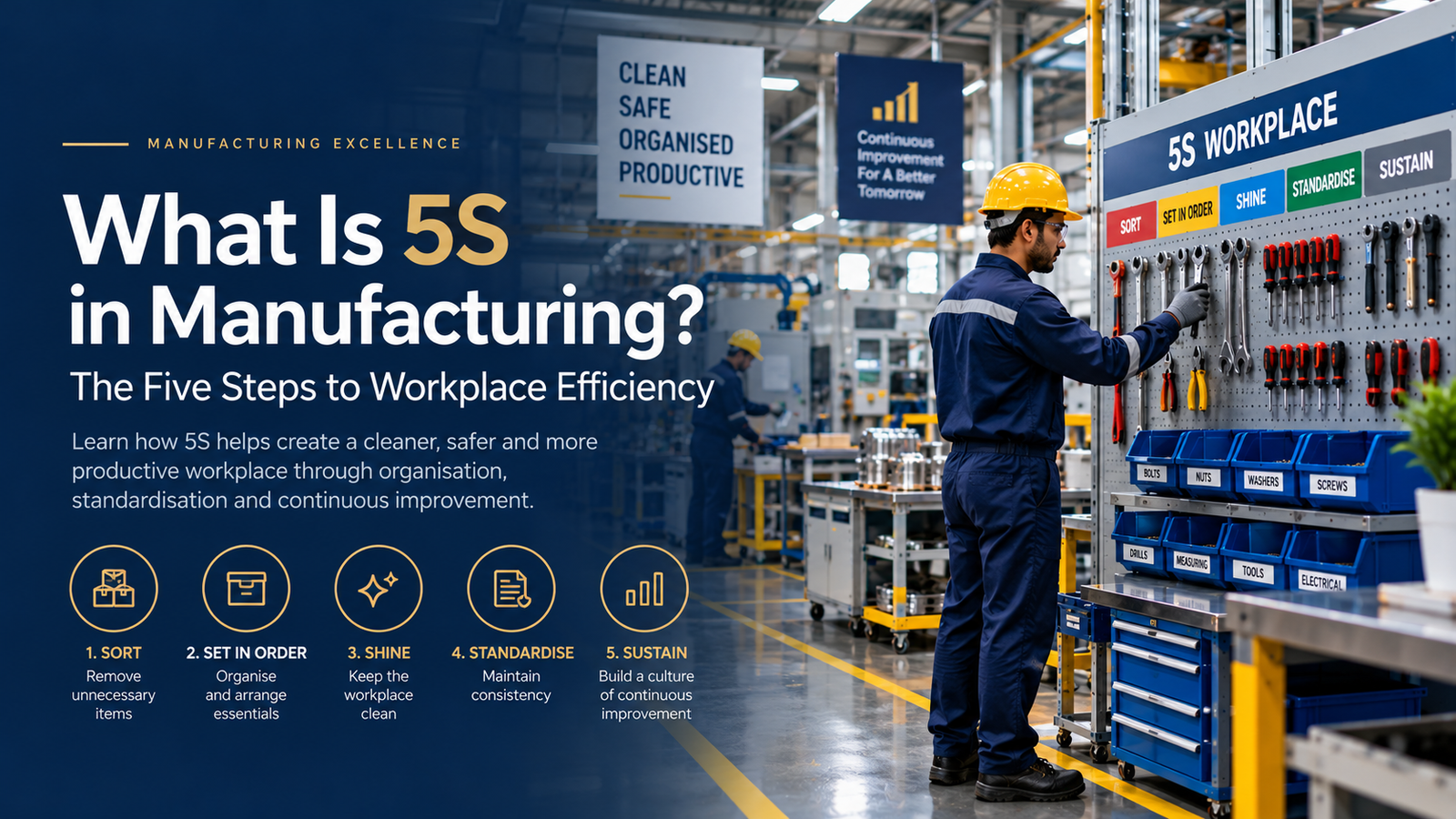
A clean, organised and well-maintained workplace is essential for efficient manufacturing operations. When tools are misplaced, materials are difficult to locate and workstations are cluttered, employees waste valuable time and production efficiency suffers.
The 5S methodology is a workplace organisation approach that helps businesses create cleaner, safer and more productive working environments. It focuses on eliminating unnecessary items, organising essential resources, maintaining cleanliness, establishing standards and developing a culture of continuous improvement.
Originally developed in Japan, 5S is widely used in manufacturing, warehouses, offices, healthcare facilities and other workplaces to improve operational performance.
1. What Is 5S in Manufacturing?
5S is a systematic workplace organisation methodology based on five Japanese principles. Each principle starts with the letter "S" and represents a step towards a more organised and efficient workplace.
The five stages are commonly translated into English as Sort, Set in Order, Shine, Standardise and Sustain.
Sort
Remove unnecessary items from the workplace and retain only what is needed.
Set in Order
Arrange essential tools, materials and equipment so they are easy to find.
Shine
Clean work areas, machines and equipment while identifying abnormalities.
Standardise
Establish consistent procedures and visual standards to maintain the first three steps.
Sustain
Develop discipline and habits that keep 5S practices active over time.
2. The Five Steps of 5S Explained
Step 1: Sort (Seiri)
The first step is to identify and remove items that are not required for daily work. Unnecessary tools, damaged equipment, unused materials and outdated documents can create clutter and slow down operations.
Practical activities include:
- Identify necessary and unnecessary workplace items.
- Remove obsolete materials and unused equipment.
- Use red-tagging to identify items requiring review.
- Keep only the resources required for the job.
Example: A production workstation contains several unused tools and old components. Employees identify and remove them, creating more usable working space.
Step 2: Set in Order (Seiton)
Once unnecessary items have been removed, the remaining resources should be organised properly. The objective is to make tools, materials and equipment easy to locate, access and return.
Practical activities include:
- Assign a fixed location to every important item.
- Use labels, colour coding and visual identification.
- Arrange frequently used tools near workstations.
- Mark storage areas and walkways clearly.
Example: A factory creates a labelled tool board so operators can quickly identify where each tool belongs and notice when something is missing.
Step 3: Shine (Seiso)
Shine focuses on keeping the workplace clean and inspecting equipment regularly. Cleaning should also help employees identify leaks, wear, damage or other unusual conditions before they become bigger problems.
Practical activities include:
- Establish daily cleaning responsibilities.
- Clean machines, floors, tools and workstations.
- Identify oil leaks, loose parts and equipment damage.
- Maintain cleaning schedules and inspection records.
Example: Operators clean machinery at the end of each shift and report unusual noise, leaks or visible damage to the maintenance team.
Step 4: Standardise (Seiketsu)
Standardisation ensures that Sort, Set in Order and Shine are performed consistently. Without clear standards, workplaces can gradually return to their previous condition.
Practical activities include:
- Create standard operating procedures and checklists.
- Use visual instructions and workplace markings.
- Define cleaning and inspection responsibilities.
- Establish regular 5S audit schedules.
Example: A factory introduces a standard end-of-shift checklist that employees complete before leaving their workstations.
Step 5: Sustain (Shitsuke)
Sustain is about maintaining the 5S system as a regular workplace habit. It requires leadership commitment, employee participation, training and continuous monitoring.
Practical activities include:
- Conduct regular 5S audits and workplace inspections.
- Train new employees on workplace standards.
- Review audit findings and assign improvement actions.
- Recognise teams that maintain good 5S practices.
- Encourage employees to suggest improvements.
Example: Management reviews monthly 5S audit results and works with employees to resolve recurring housekeeping and organisation issues.
3. Benefits of Implementing 5S
A properly implemented 5S programme can improve daily operations and support a more disciplined workplace. Its benefits include:
Improved Productivity
Employees spend less time searching for tools, materials and information.
Better Workplace Safety
Clear walkways and organised work areas help reduce workplace hazards.
Reduced Waste
Better organisation helps reduce unnecessary movement, searching and handling.
Improved Equipment Care
Regular cleaning and inspection help identify abnormalities earlier.
Higher Employee Involvement
Employees participate in improving their own work environment.
Consistent Work Practices
Standard procedures help maintain organised and repeatable operations.
4. How to Implement 5S in a Manufacturing Facility
Successful implementation requires more than a one-time cleaning activity. Businesses should introduce 5S through a planned programme with clear responsibilities and regular reviews.
-
Get Management Commitment
Explain the objectives of 5S, define responsibilities and ensure management supports the programme. -
Select a Pilot Area
Begin with one production line, workstation, warehouse section or office area before expanding across the facility. -
Conduct Initial Workplace Assessment
Record the current condition using photographs, observations and an initial 5S assessment. -
Train Employees
Explain the five principles and show employees how to apply them in their daily activities. -
Apply the Five S Stages
Implement Sort, Set in Order, Shine, Standardise and Sustain in a planned sequence. -
Introduce Visual Management
Use labels, floor markings, tool boards, signs and checklists to make workplace standards visible. -
Conduct Regular Audits
Evaluate workplace conditions, record findings and identify areas that require improvement. -
Review and Improve
Track progress, assign corrective actions and encourage employee suggestions for improvement.
5. What Is a 5S Audit?
A 5S audit is a structured assessment used to evaluate how effectively the five principles are being followed in a workplace. It helps organisations identify gaps, measure progress and maintain standards.
A typical 5S audit may review the following areas:
| 5S Stage | Audit Checkpoints |
|---|---|
| Sort | Are unnecessary items removed from the work area? |
| Set in Order | Are tools and materials labelled and stored correctly? |
| Shine | Are machines and workstations clean and inspected? |
| Standardise | Are checklists, procedures and visual standards followed? |
| Sustain | Are employees maintaining 5S practices consistently? |
Organisations can use a scoring system, such as a 1-to-5 rating for each audit checkpoint. The scoring method should be defined consistently so that results can be compared across departments and audit periods.
6. Common Mistakes to Avoid During 5S Implementation
Some organisations introduce 5S with enthusiasm but struggle to maintain it over time. The following mistakes can weaken the programme:
- Treating 5S as a one-day cleaning campaign.
- Implementing the system without employee involvement.
- Failing to assign clear workplace responsibilities.
- Using labels and markings without maintaining them.
- Ignoring audit findings and repeated problems.
- Focusing only on appearance instead of process improvement.
- Lacking management support and regular follow-up.
7. How 5S Supports ISO 9001 and Other Management Systems
5S is not itself an ISO certification standard. However, its practices can support the implementation and maintenance of management systems such as ISO 9001, ISO 14001 and ISO 45001.
- ISO 9001: Organised workplaces and standardised practices can support process control and consistent product quality.
- ISO 14001: Better workplace organisation can support waste segregation, housekeeping and environmental controls.
- ISO 45001: Clear walkways, organised storage and regular inspections can support workplace hazard identification and safety practices.
Organisations should still meet the specific requirements of each applicable management system. Implementing 5S alone does not establish conformity or guarantee certification.
8. Frequently Asked Questions About 5S
Q1. What does 5S stand for?
5S stands for Sort, Set in Order, Shine, Standardise and Sustain. These five principles help organisations maintain an organised and efficient workplace.
Q2. Is 5S only used in manufacturing?
No. Although widely used in manufacturing, 5S can also be applied in offices, warehouses, hospitals, workshops, laboratories and other work environments.
Q3. What is the main objective of 5S?
The main objective is to create and maintain a clean, organised, safe and efficient workplace by eliminating unnecessary items and establishing consistent practices.
Q4. What is the difference between 5S and Kaizen?
5S focuses on workplace organisation and discipline. Kaizen is a broader approach to continuous improvement through ongoing, incremental changes. Both can be used together.
Q5. How often should a 5S audit be conducted?
Audit frequency depends on workplace needs and the organisation's programme. Many businesses conduct regular weekly or monthly reviews, with additional checks where necessary.
Q6. Does 5S require certification?
No. 5S is a workplace improvement methodology and does not have a standalone ISO certification requirement.
Q7. Can small businesses implement 5S?
Yes. 5S can be introduced in small businesses using simple workplace assessments, clear storage arrangements, cleaning routines and regular reviews.
Build a More Efficient and Organised Workplace
Improve workplace organisation, strengthen operational discipline and encourage continuous improvement with professional guidance from Vedanta Management Advisory Group.
Talk to Our ExpertsDisclaimer: This article is intended for general educational purposes. The implementation of 5S should be adapted to the specific activities, operational risks and requirements of each organisation.