
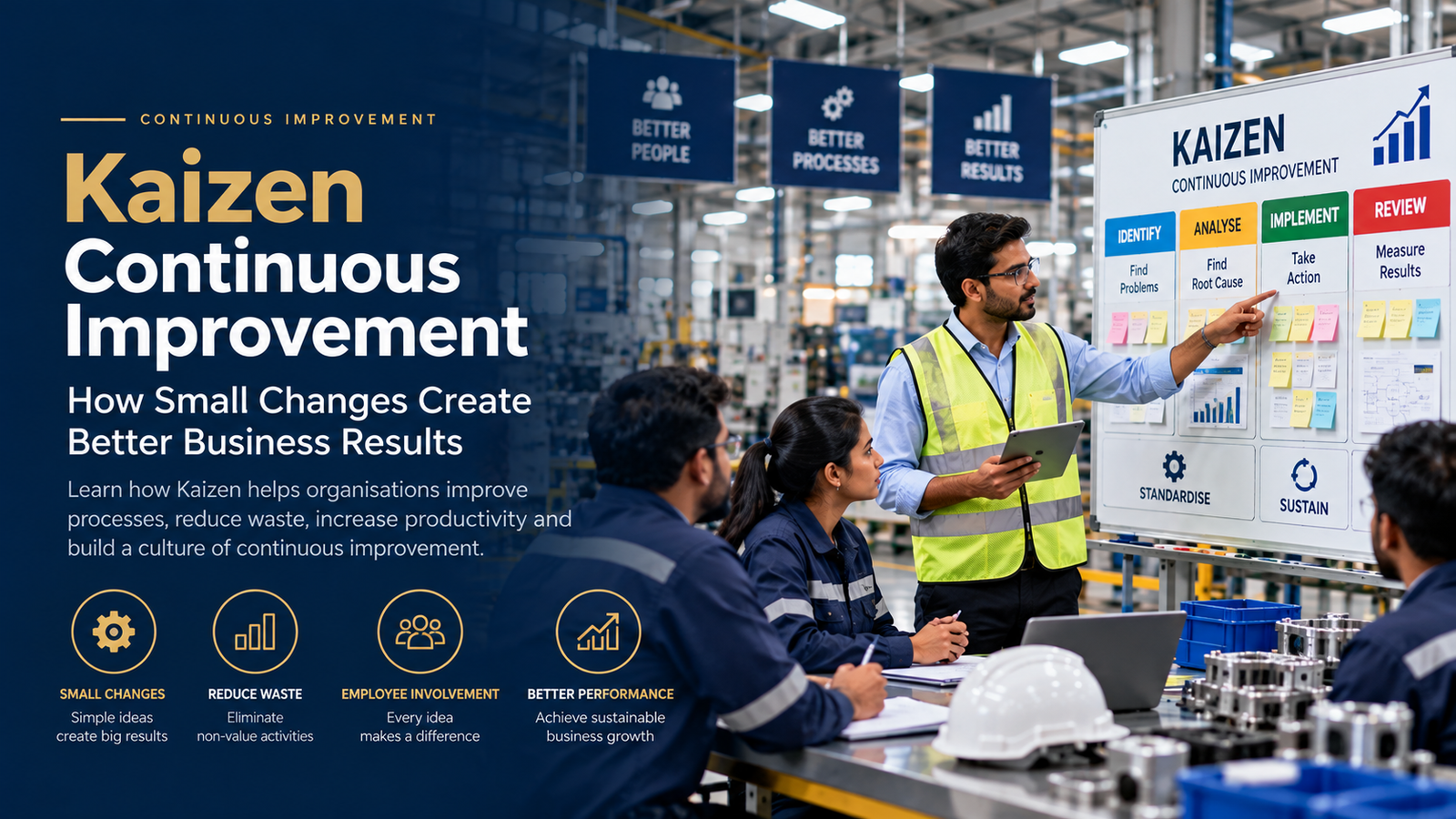
Successful businesses do not always improve through major investments or dramatic changes. Sometimes, the most meaningful results come from small improvements made consistently over time. This is the central idea behind Kaizen.
Kaizen is a Japanese philosophy of continuous improvement that encourages employees at every level to identify problems, suggest better ways of working and make processes more effective.
From manufacturing facilities and warehouses to offices and service organisations, Kaizen can help businesses reduce waste, improve quality, increase productivity and create a culture where improvement becomes part of everyday work.
1. What Is Kaizen?
The word Kaizen comes from two Japanese words: "Kai", meaning change, and "Zen", meaning good. Together, Kaizen is commonly understood as "change for the better".
In business, Kaizen refers to an ongoing approach to improving products, processes, services and workplace practices through small, practical changes.
Instead of depending only on large improvement projects, Kaizen encourages regular participation from employees, supervisors and management.
Employees who perform daily tasks often understand operational problems better than anyone else. Kaizen gives them an opportunity to share their ideas and contribute to better business results.
2. Core Principles of Kaizen
Effective Kaizen implementation depends on a few important principles that guide how organisations identify and achieve improvements.
Employee Involvement
Encourage employees at every level to participate in identifying problems and suggesting improvements.
Process Improvement
Focus on improving the way work is performed instead of simply blaming individuals.
Waste Reduction
Identify activities that consume time, materials or resources without adding value.
Small Continuous Changes
Make manageable improvements regularly and build on successful results.
Data-Based Decisions
Measure process performance and use facts to understand whether an improvement works.
Standardisation
Maintain successful improvements through updated procedures and consistent practices.
3. How Does the Kaizen Process Work?
Kaizen can be implemented through a structured improvement cycle. One commonly used approach is the PDCA cycle: Plan, Do, Check and Act.
Step 1: Plan
Identify a problem or opportunity for improvement. Understand the current process, collect relevant data and decide what change should be tested.
Step 2: Do
Implement the proposed improvement on a small scale or within a controlled area. Record what happens during the trial.
Step 3: Check
Review the results and compare them with the original situation. Determine whether the change achieved the expected improvement.
Step 4: Act
If the change is successful, standardise it and apply it more broadly where appropriate. If it does not work, learn from the results and begin another improvement cycle.
4. Kaizen Examples in Manufacturing
Kaizen can be applied to many everyday manufacturing challenges. The following examples show how small improvements can make a practical difference.
Reducing Tool Search Time
Introduce labelled tool storage and fixed locations so operators spend less time searching for equipment.
Improving Material Movement
Rearrange materials and workstation layouts to reduce unnecessary movement during production.
Reducing Product Defects
Identify recurring defects, investigate root causes and introduce process controls to prevent repetition.
Improving Machine Maintenance
Introduce routine inspection and maintenance checks to identify equipment abnormalities earlier.
Improving Production Flow
Review bottlenecks and adjust work sequences to support smoother production operations.
Reducing Paperwork
Simplify repetitive reporting processes and remove unnecessary approval steps.
5. How Kaizen Improves Overall Business Performance
Although Kaizen is strongly associated with manufacturing, its principles can be used across different business functions and industries.
| Business Area | Possible Kaizen Improvement |
|---|---|
| Manufacturing | Reduce defects, downtime and unnecessary movement. |
| Human Resources | Simplify employee onboarding and training processes. |
| Customer Service | Improve complaint handling and response procedures. |
| Sales | Improve lead follow-up and customer communication. |
| Warehousing | Improve inventory organisation and picking processes. |
| Administration | Reduce repetitive paperwork and approval delays. |
6. Benefits of Kaizen for Businesses
A consistent improvement culture can help organisations strengthen their operations and make better use of available resources.
- Higher productivity: Improved workflows help employees complete tasks more efficiently.
- Better product quality: Regular process reviews help identify and address the causes of defects.
- Reduced operational waste: Businesses can identify unnecessary activities, waiting time and resource consumption.
- Employee engagement: Employees feel involved when their suggestions are considered and implemented.
- Improved customer satisfaction: Better processes can contribute to consistent products and more reliable services.
- Better teamwork: Cross-functional improvement activities encourage communication and collaboration.
- Long-term improvement culture: Regular reviews help organisations maintain improvements and identify new opportunities.
7. How to Implement Kaizen in Your Organisation
Kaizen should be introduced as an ongoing management approach rather than a one-time activity. A structured implementation plan can help employees understand their roles and participate effectively.
-
Obtain Management Commitment
Management should communicate the purpose of Kaizen, support improvement activities and provide necessary resources. -
Identify Improvement Opportunities
Review operational problems, employee suggestions, customer complaints and process performance data. -
Involve Employees
Encourage employees to report problems and suggest practical solutions based on their daily experience. -
Analyse the Root Cause
Use appropriate problem-solving methods such as the 5 Whys and cause-and-effect analysis. -
Develop and Test Improvements
Select suitable solutions and test them on a small scale before wider implementation. -
Measure the Results
Compare relevant performance indicators before and after the improvement. -
Standardise Successful Changes
Update work instructions, procedures and training materials where necessary. -
Review and Repeat
Monitor the results and encourage teams to identify the next improvement opportunity.
8. Important Tools Used in Kaizen
Organisations use several quality and process improvement tools to support Kaizen activities. The appropriate tool depends on the problem being investigated.
5 Whys Analysis
Repeatedly asks why a problem occurred to help identify its underlying cause.
Fishbone Diagram
Organises possible causes of a problem into categories for systematic investigation.
5S Methodology
Helps maintain organised, clean and efficient workplace environments.
PDCA Cycle
Provides a structured approach to planning, testing, checking and standardising improvements.
Value Stream Mapping
Helps visualise material and information flows and identify process waste.
Performance Indicators
Measures operational results such as defects, cycle time, downtime and productivity.
9. Kaizen vs. Lean vs. Six Sigma
Kaizen, Lean and Six Sigma are related improvement approaches, but they have different areas of emphasis. They can also be used together within an organisation.
| Approach | Main Focus | Typical Application |
|---|---|---|
| Kaizen | Continuous incremental improvement. | Everyday process and workplace improvements. |
| Lean | Eliminating waste and improving value flow. | Improving process efficiency and workflow. |
| Six Sigma | Reducing process variation and defects. | Data-driven quality and process improvement. |
Kaizen encourages ongoing improvements, Lean focuses on value and waste reduction, while Six Sigma uses statistical methods to reduce variation and defects. Many organisations combine these approaches to strengthen their improvement programmes.
10. Common Challenges in Kaizen Implementation
Even simple improvement programmes can face challenges if employees and management do not consistently support them.
- Lack of management commitment.
- Limited employee participation.
- Resistance to changing existing work practices.
- Failure to investigate the actual root cause.
- Implementing changes without measuring results.
- Not standardising successful improvements.
- Expecting immediate results from a long-term approach.
To overcome these challenges, organisations should provide suitable training, communicate improvement objectives, recognise employee contributions and regularly review the effectiveness of changes.
11. How Kaizen Supports ISO Management Systems
Kaizen is not an ISO certification standard. However, its continuous improvement philosophy can support organisations implementing and maintaining management systems.
- ISO 9001: Supports process improvement, customer satisfaction and corrective-action activities.
- ISO 14001: Can help improve environmental performance and operational controls.
- ISO 45001: Encourages worker participation and improvements in occupational health and safety processes.
- IATF 16949: Supports defect prevention, process improvement and automotive quality objectives.
Kaizen can help build a culture of continual improvement, but organisations must still meet the specific requirements of the relevant management system standards.
12. Frequently Asked Questions About Kaizen
Q1. What does Kaizen mean?
Kaizen is a Japanese term commonly translated as "change for the better". In business, it describes continuous improvement through ongoing, practical changes.
Q2. What is the main objective of Kaizen?
Its main objective is to improve processes, quality and productivity by encouraging employees to identify and implement improvements regularly.
Q3. What is the PDCA cycle in Kaizen?
PDCA stands for Plan, Do, Check and Act. It is a structured cycle used to test improvements, evaluate results and maintain successful changes.
Q4. Is Kaizen only suitable for manufacturing?
No. Kaizen can be applied in manufacturing, healthcare, education, retail, logistics, administration and other service industries.
Q5. What is the difference between Kaizen and 5S?
5S is a workplace organisation methodology, while Kaizen is a broader philosophy of continuous improvement. 5S can be used as one of the practical approaches within a Kaizen programme.
Q6. Does Kaizen require a large investment?
Many Kaizen improvements involve simple, low-cost changes. However, some improvements may require investment depending on the problem and proposed solution.
Q7. Who should participate in Kaizen?
Employees, supervisors, managers and relevant support teams should participate. Improvement activities are most effective when people involved in the processes contribute their knowledge and experience.
Make Continuous Improvement Part of Your Business
Strengthen your processes, encourage employee involvement and improve operational performance with professional guidance from Vedanta Management Advisory Group.
Talk to Our ExpertsDisclaimer: This article is intended for general educational purposes. Kaizen practices should be adapted to the organisation's processes, objectives and operational requirements.