
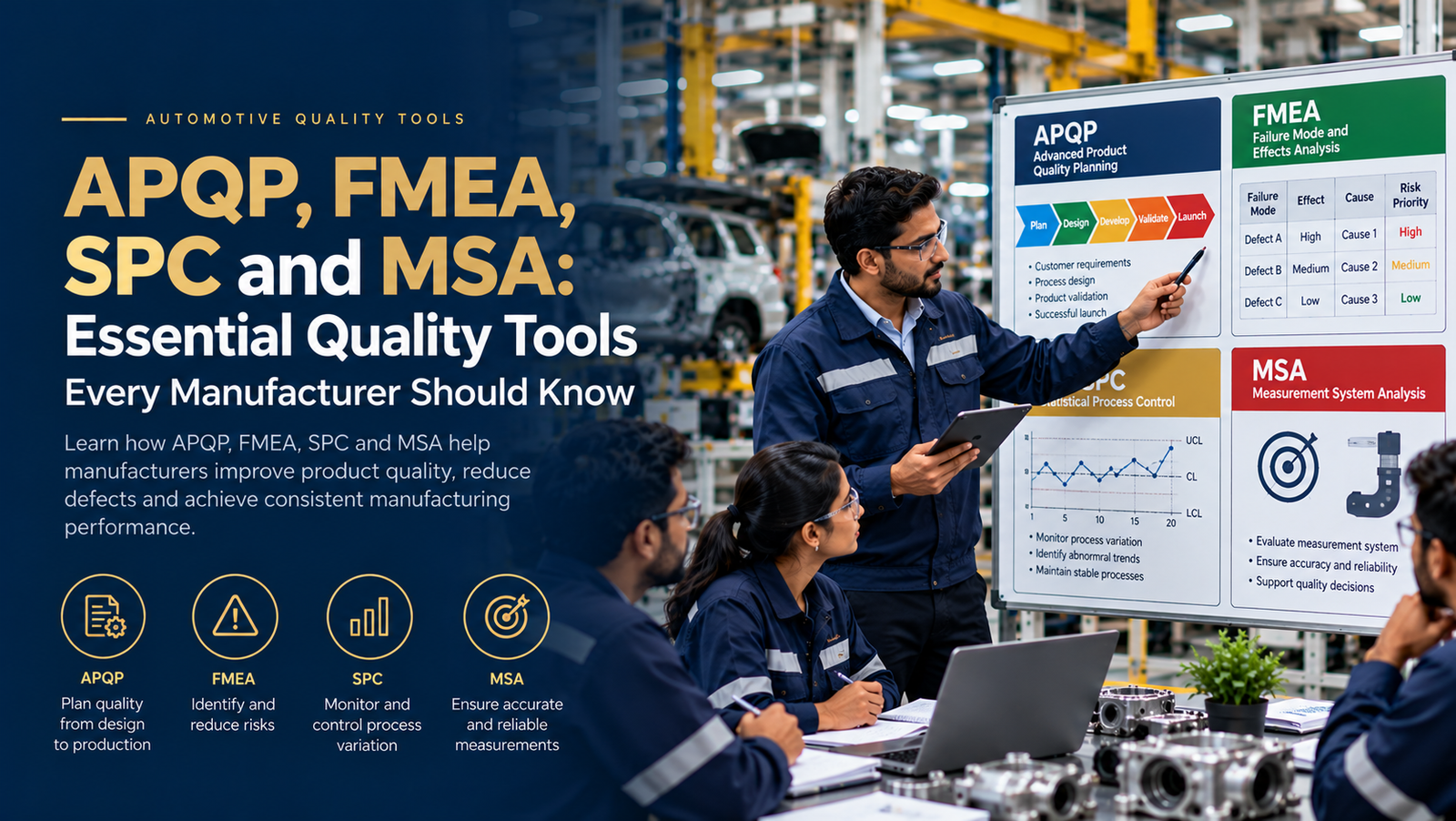
Manufacturing businesses must consistently deliver products that meet customer expectations, engineering specifications and quality requirements. Achieving this requires effective planning, risk management, process monitoring and reliable measurement systems.
Four important quality tools used across the automotive industry are APQP, FMEA, SPC and MSA. These methods help organisations plan product quality, identify potential failures, monitor manufacturing processes and ensure that measurement results can be trusted.
Understanding these tools is essential for quality professionals, production managers, engineers, suppliers and organisations implementing IATF 16949 requirements.
1. What Are APQP, FMEA, SPC and MSA?
APQP
Advanced Product Quality Planning helps organisations plan quality throughout product and process development.
FMEA
Failure Mode and Effects Analysis identifies potential failures and helps prioritise preventive actions.
SPC
Statistical Process Control uses data and statistical techniques to monitor process behaviour.
MSA
Measurement System Analysis evaluates whether measurement results are suitable and reliable.
2. APQP – Advanced Product Quality Planning
APQP is a structured methodology used to plan product quality and manufacturing processes before production begins.
Its purpose is to ensure that customer requirements are understood, product risks are considered, manufacturing processes are developed and validation activities are completed.
Objectives of APQP
- Understand customer requirements and expectations.
- Plan product and manufacturing process development.
- Identify potential quality risks early.
- Coordinate activities between departments and suppliers.
- Validate products and manufacturing processes before launch.
- Support consistent production and customer satisfaction.
The Five Phases of APQP
-
Plan and Define the Programme
Understand customer requirements, project objectives, product expectations and initial feasibility. -
Product Design and Development
Develop product specifications, evaluate design risks and perform appropriate design validation activities where applicable. -
Process Design and Development
Establish manufacturing processes, layouts, process flow diagrams, control plans and process-related risk assessments. -
Product and Process Validation
Validate the product and production process using appropriate testing, trials and production part approval activities. -
Feedback, Assessment and Corrective Action
Review production performance, customer feedback and quality data to maintain and improve the manufacturing process.
3. FMEA – Failure Mode and Effects Analysis
FMEA is a structured risk analysis method used to identify how a product, process or system could fail and understand the possible effects of those failures.
It helps organisations take preventive action before failures occur, rather than depending only on inspection after production.
Types of FMEA
DFMEA – Design FMEA
Evaluates potential failures related to product design and design requirements.
PFMEA – Process FMEA
Evaluates potential failures in manufacturing and assembly processes.
System FMEA
Evaluates potential failures at a system or subsystem level where applicable.
Supplemental FMEA
Other forms may be used depending on the organisation, product and risk context.
Important Elements of FMEA
- Failure Mode: How a product or process could fail.
- Failure Effect: The potential consequence of the failure.
- Failure Cause: Why the failure might occur.
- Severity: The seriousness of the potential effect.
- Occurrence: The likelihood or frequency of the cause occurring.
- Detection: The effectiveness of controls in detecting the issue.
- Action Priority: Helps determine the priority of recommended actions under the applicable FMEA method.
Modern AIAG and VDA FMEA methodology uses Action Priority (AP) to guide prioritisation. Some organisations and legacy customer requirements may still refer to Risk Priority Numbers (RPN). Always follow the applicable customer and industry requirements.
Simple FMEA Example
| Process | Potential Failure | Possible Effect | Preventive Action |
|---|---|---|---|
| Component Assembly | Incorrect fastening | Component may loosen. | Control fastening parameters and verification. |
| Surface Treatment | Uneven coating | Reduced corrosion protection. | Monitor process conditions and inspection results. |
| Packaging | Insufficient protection | Product damage during transportation. | Validate packaging and handling methods. |
4. SPC – Statistical Process Control
Statistical Process Control is a method of monitoring and controlling manufacturing processes using statistical data.
SPC helps organisations understand process variation and identify unusual changes before they lead to significant quality problems.
Objectives of SPC
- Monitor manufacturing process performance.
- Identify unusual process variation.
- Understand whether a process is statistically stable.
- Support timely investigation and corrective action.
- Improve consistency in product quality.
Common SPC Tools
Control Charts
Display process data over time with a centre line and statistically determined control limits.
Histograms
Show the distribution and frequency of measured values.
Process Capability Analysis
Evaluates process performance relative to defined specification limits, using appropriate assumptions.
Run Charts
Display data over time to help identify patterns and trends.
Control Limits vs. Specification Limits
These two concepts should not be confused.
- Control limits: Calculated from process data and used to evaluate process behaviour.
- Specification limits: Defined by design, engineering or customer requirements.
A process can be statistically stable but still fail to meet customer specifications. Likewise, a process may currently meet specifications while showing signs of instability that require investigation.
5. MSA – Measurement System Analysis
Measurement System Analysis evaluates the quality and reliability of measurement systems used to make manufacturing decisions.
Even when a manufacturing process is performing correctly, an unreliable measurement system can produce misleading results.
Objectives of MSA
- Evaluate measurement system variation.
- Understand measurement repeatability and reproducibility.
- Assess measurement accuracy and stability where applicable.
- Determine whether equipment is suitable for its intended use.
- Improve confidence in inspection and process data.
Important MSA Concepts
Accuracy
How close a measurement result is to the accepted reference value.
Repeatability
Variation when the same operator measures the same item using the same equipment under similar conditions.
Reproducibility
Variation associated with different operators or other relevant measurement conditions.
Stability
Consistency of measurement performance over time.
Linearity
Whether measurement bias remains consistent across the operating measurement range.
Bias
The difference between the observed average measurement and an accepted reference value.
What Is a Gage R&R Study?
Gage Repeatability and Reproducibility (Gage R&R) is a commonly used MSA study that evaluates measurement variation associated with equipment and operators.
It helps determine whether a measurement system is suitable for its intended manufacturing application.
6. Difference Between APQP, FMEA, SPC and MSA
| Tool | Main Purpose | When It Is Used | Key Outcome |
|---|---|---|---|
| APQP | Plan product and process quality. | Product and process development. | Structured quality planning. |
| FMEA | Identify and prioritise potential failures. | Design and process risk assessment. | Risk reduction actions. |
| SPC | Monitor process variation. | Production and process monitoring. | Process stability information. |
| MSA | Evaluate measurement reliability. | Before relying on measurement data. | Confidence in measurement results. |
7. How These Four Tools Work Together
APQP, FMEA, SPC and MSA are most effective when used as connected parts of a quality planning and control system.
-
APQP – Plan the Product and Process
Establish customer requirements, development activities, process plans and validation needs. -
FMEA – Identify Potential Risks
Assess possible product and manufacturing failures and plan appropriate preventive actions. -
MSA – Validate Measurement Systems
Evaluate whether inspection and measurement systems provide reliable data for decisions. -
SPC – Monitor Process Performance
Use statistical monitoring to understand process behaviour and investigate unusual variation. -
Review and Improve
Use production feedback, inspection results and process performance to update plans and improve controls.
8. Benefits of Using These Quality Tools
- Better planning during product development and launch.
- Early identification of potential product and process failures.
- Improved process monitoring and control.
- More reliable measurement and inspection decisions.
- Reduced risk of recurring manufacturing defects.
- Improved communication between departments and suppliers.
- Stronger evidence of quality planning and control.
- Better support for customer-specific quality requirements.
9. How to Implement These Tools in Your Organisation
-
Understand Customer Requirements
Identify relevant specifications, product characteristics and customer-specific requirements. -
Develop a Quality Planning Process
Establish responsibilities, timelines, reviews and required quality deliverables. -
Conduct Risk Assessments
Use appropriate FMEA methods to identify potential failures and prioritise actions. -
Evaluate Measurement Systems
Conduct suitable MSA studies before relying on measurement data for decisions. -
Establish Process Monitoring
Select appropriate process characteristics, sampling methods and SPC techniques. -
Train Relevant Employees
Develop employee competence in quality planning, risk analysis and statistical tools. -
Review Results and Improve
Monitor effectiveness, address identified problems and update quality plans and controls.
10. Common Mistakes to Avoid
- Preparing APQP documents without effective cross-functional involvement.
- Treating FMEA as a paperwork exercise instead of a living risk assessment.
- Using outdated FMEA information after process changes.
- Confusing SPC control limits with engineering specification limits.
- Using measurement data without checking measurement system suitability.
- Ignoring customer-specific requirements.
- Failing to review and update quality plans after changes or new risks.
11. Frequently Asked Questions
Q1. What are APQP, FMEA, SPC and MSA?
They are important quality planning, risk assessment, process monitoring and measurement analysis methods used in manufacturing, especially in the automotive supply chain.
Q2. Is APQP mandatory under IATF 16949?
IATF 16949 includes requirements related to product and process design and development planning. The specific planning approach and deliverables should follow applicable customer-specific requirements.
Q3. What is the difference between DFMEA and PFMEA?
DFMEA evaluates potential failures related to product design, while PFMEA evaluates potential failures in manufacturing processes.
Q4. What is the purpose of SPC?
SPC monitors process behaviour using statistical techniques so organisations can identify unusual variation and maintain better process control.
Q5. What does Gage R&R mean?
Gage R&R stands for Gage Repeatability and Reproducibility. It evaluates measurement variation associated with equipment and operators.
Q6. Are these tools only used in the automotive industry?
No. These methods can also be adapted for aerospace, electronics, medical devices and other manufacturing sectors, depending on industry requirements.
Q7. Do employees need training in these tools?
Yes. Employees responsible for quality planning, risk assessments, process monitoring and measurement analysis should receive appropriate training for their roles.
Strengthen Your Manufacturing Quality System
Improve quality planning, reduce process risks and strengthen manufacturing controls with professional guidance from Vedanta Management Advisory Group.
Talk to Our ExpertsDisclaimer: This article provides general educational information. Specific methodologies, formats and requirements should follow applicable standards, current industry guidance and customer-specific requirements.