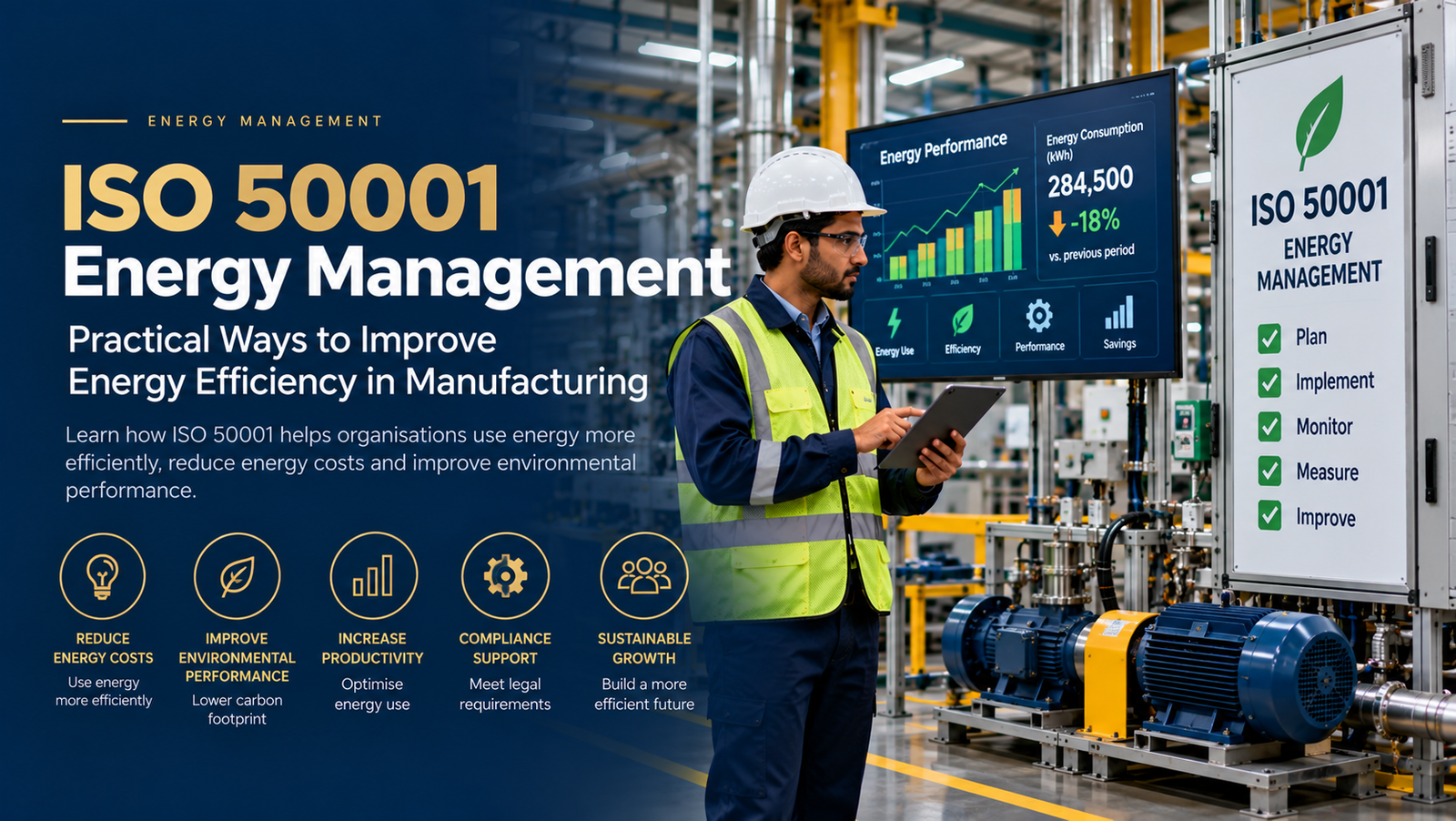
Energy is one of the major operating costs for many manufacturing organisations. Electricity, fuel, compressed air, heating, cooling and production machinery all contribute to energy consumption.
As energy costs and environmental expectations continue to grow, businesses need effective ways to monitor and improve their energy performance. ISO 50001 provides an internationally recognised framework for establishing, implementing and continually improving an Energy Management System (EnMS).
By applying ISO 50001, organisations can understand where energy is consumed, identify opportunities for improvement, establish performance targets and monitor progress.
1. What Is ISO 50001?
ISO 50001 is an international standard that specifies requirements for establishing, implementing, maintaining and improving an Energy Management System.
It provides organisations with a structured approach to managing energy use and consumption. The standard is based on the Plan-Do-Check-Act (PDCA) improvement cycle.
ISO 50001 can be implemented by organisations of different sizes and sectors, including manufacturing facilities, commercial buildings, hospitals, warehouses and service organisations.
2. Main Objectives of ISO 50001
Improve Energy Performance
Identify opportunities to improve energy efficiency and optimise energy consumption.
Manage Energy Costs
Understand energy expenses and reduce avoidable energy waste.
Monitor Energy Use
Establish measurements and indicators to evaluate energy performance.
Support Continual Improvement
Regularly review energy performance and implement suitable improvements.
Manage Energy Obligations
Identify and evaluate applicable legal and other energy-related requirements.
Improve Environmental Performance
Support more efficient energy use and help manage energy-related environmental impacts.
3. Who Can Implement ISO 50001?
ISO 50001 is suitable for organisations that want to establish a systematic approach to energy management, regardless of their size, industry or energy consumption level.
- Manufacturing and industrial facilities.
- Automotive and engineering companies.
- Hospitals and healthcare facilities.
- Commercial buildings and office complexes.
- Hotels and hospitality businesses.
- Warehouses and logistics centres.
- Educational institutions.
- Food processing and packaging industries.
- Data centres and technology facilities.
4. Key Requirements of ISO 50001
ISO 50001 follows the common high-level structure used by many ISO management system standards. Its requirements focus specifically on energy management and energy performance.
4.1 Context of the Organisation
Organisations must understand internal and external issues that affect their energy management objectives. They should identify relevant interested parties and define the scope and boundaries of the Energy Management System.
4.2 Leadership and Commitment
Top management must demonstrate leadership and commitment to the Energy Management System. This includes establishing an energy policy, assigning responsibilities and supporting the resources needed for implementation.
4.3 Planning
Organisations must identify energy-related risks and opportunities, conduct energy reviews, establish energy baselines and determine relevant energy performance indicators.
4.4 Support
This includes providing resources, competence, awareness, communication and documented information needed to support the system.
4.5 Operation
Organisations must plan, implement and control operations that affect energy performance. They should also consider energy performance in relevant design, procurement and operational decisions.
4.6 Performance Evaluation
Energy performance must be monitored, measured, analysed and evaluated. Internal audits and management reviews help assess whether the system is effective.
4.7 Improvement
Organisations should address nonconformities, take corrective action and continually improve the suitability, adequacy and effectiveness of the Energy Management System.
5. What Is an Energy Review?
An energy review is a systematic examination of energy use and consumption within an organisation.
It helps identify significant energy uses, understand the factors affecting consumption and determine opportunities for improving energy performance.
Typical Activities in an Energy Review
- Collect and analyse relevant energy data.
- Identify energy sources such as electricity, gas and fuel.
- Review historical energy consumption.
- Identify significant energy uses.
- Determine relevant variables affecting energy consumption.
- Identify opportunities for energy performance improvement.
- Establish priorities for monitoring and action.
6. Energy Performance Indicators and Baselines
What Is an Energy Performance Indicator?
An Energy Performance Indicator (EnPI) is a measurable value or measure used to evaluate energy performance.
Examples include:
- Electricity consumption per unit produced.
- Energy consumption per square metre of building area.
- Fuel consumption per kilometre travelled.
- Energy consumption per operating hour.
- Energy consumption per tonne of processed material.
What Is an Energy Baseline?
An Energy Baseline (EnB) is a quantitative reference used to compare energy performance over time. It is established using suitable data and a defined period.
Energy performance indicators can be compared against the baseline to determine whether energy performance has improved.
7. Practical Ways to Improve Energy Efficiency in Manufacturing
Manufacturing organisations can apply different technical and operational improvements to reduce unnecessary energy consumption.
Optimise Equipment Operation
Review operating schedules, idle time and machine settings to avoid unnecessary energy use.
Improve Motor Efficiency
Evaluate motor performance, loading and suitable energy-efficient motor technologies.
Identify Air Leakage
Inspect compressed air systems and repair leakage to reduce avoidable energy losses.
Upgrade Lighting Systems
Consider efficient lighting, occupancy controls and suitable natural lighting arrangements.
Optimise Heating and Cooling
Review HVAC schedules, temperature settings, insulation and equipment maintenance.
Implement Preventive Maintenance
Maintain equipment to reduce avoidable energy losses caused by poor operating conditions.
8. Benefits of ISO 50001 Certification
Implementing an effective Energy Management System can deliver operational and organisational benefits.
- Better energy efficiency: Helps identify and act on opportunities to improve energy performance.
- Improved cost management: Supports better understanding and control of energy-related expenses.
- Reduced energy waste: Helps identify unnecessary consumption and inefficient practices.
- Better operational control: Establishes a systematic approach to monitoring significant energy uses.
- Improved decision-making: Uses energy data and performance indicators to guide decisions.
- Environmental benefits: Improved energy efficiency may contribute to reducing energy-related emissions, depending on the energy sources used.
- Customer confidence: Demonstrates a structured commitment to energy management.
- Continual improvement: Encourages regular review and improvement of energy performance.
9. How to Implement ISO 50001 in Your Organisation
-
Define the Scope
Identify the facilities, operations, activities and boundaries covered by the Energy Management System. -
Obtain Management Commitment
Establish leadership support, an energy policy and appropriate responsibilities. -
Conduct an Energy Review
Analyse energy sources, consumption patterns, significant energy uses and improvement opportunities. -
Establish Energy Baselines and EnPIs
Define suitable indicators and reference periods for evaluating energy performance. -
Set Energy Objectives and Targets
Establish measurable objectives, action plans and responsibilities. -
Implement Operational Controls
Establish controls for activities that affect significant energy uses. -
Train and Involve Employees
Develop awareness and competence among employees whose activities affect energy performance. -
Monitor and Measure Performance
Track energy consumption, indicators and progress against objectives. -
Conduct Internal Audits and Management Reviews
Evaluate system conformity and identify opportunities for improvement. -
Prepare for Certification
Address identified gaps and arrange an external certification audit with an appropriate certification body.
10. Important Documents and Records
Organisations should maintain documented information required by ISO 50001 and information they determine necessary for effective operation of the system.
- Energy Management System scope and boundaries.
- Energy policy.
- Energy review information and results.
- Energy baselines and performance indicators.
- Energy objectives, targets and action plans.
- Energy consumption and monitoring records.
- Operational control information.
- Competence and training records.
- Internal audit programme and audit reports.
- Management review records.
- Nonconformity and corrective action records.
11. ISO 50001 Certification Process
Organisations seeking certification should implement the Energy Management System and arrange an independent certification audit through a suitable certification body.
Gap Analysis
Evaluate existing energy management practices against ISO 50001 requirements.
System Implementation
Develop and implement the required energy management processes.
Internal Audit
Review system conformity and identify areas requiring corrective action.
Management Review
Evaluate performance, objectives, audit results and improvement needs.
External Certification Audit
The certification body evaluates conformity through its certification process.
Certification and Surveillance
Certification is granted following a positive certification decision. Ongoing surveillance and recertification follow the applicable certification scheme.
12. Difference Between ISO 50001 and ISO 14001
ISO 50001 and ISO 14001 both support environmental and sustainability-related management, but they have different primary focuses.
| Aspect | ISO 50001 | ISO 14001 |
|---|---|---|
| Main Focus | Energy management and energy performance. | Environmental management and environmental performance. |
| Primary Objective | Improve energy performance. | Manage environmental aspects and impacts. |
| Key Activities | Energy reviews, baselines and EnPIs. | Environmental aspects, impacts and compliance obligations. |
| Typical Application | Energy consumption and efficiency improvement. | Waste, emissions, resource use and environmental controls. |
Organisations may implement both standards together using an integrated management system where appropriate.
13. Common Challenges in ISO 50001 Implementation
- Limited understanding of energy consumption patterns.
- Incomplete or unreliable energy data.
- Lack of management commitment and resources.
- Difficulty identifying significant energy uses.
- Unclear energy performance indicators.
- Insufficient employee awareness and training.
- Failure to monitor energy improvement actions.
- Not reviewing energy performance regularly.
Organisations can address these challenges through management support, reliable data collection, employee involvement, clear responsibilities and regular performance reviews.
14. Frequently Asked Questions
Q1. What is ISO 50001 in simple words?
ISO 50001 is an international standard that helps organisations manage energy use systematically and continually improve energy performance.
Q2. Is ISO 50001 only for manufacturing companies?
No. It can be implemented by organisations across different industries, including hospitals, offices, hotels, warehouses and educational institutions.
Q3. What is an Energy Management System?
An Energy Management System is a set of policies, processes, responsibilities and controls used to manage and improve an organisation's energy performance.
Q4. What is an energy baseline?
An energy baseline is a quantitative reference used to compare energy performance over time.
Q5. What is an EnPI?
An Energy Performance Indicator is a measurable value used to evaluate energy performance, such as energy consumed per unit of production.
Q6. Does ISO 50001 guarantee lower energy bills?
No. Certification does not guarantee a specific reduction in energy costs. However, an effectively implemented system can help identify and manage energy performance improvement opportunities.
Q7. What is the current version of ISO 50001?
ISO 50001:2018 is the published international edition commonly used for certification. Organisations should check the latest ISO publications and applicable amendments when planning implementation or certification.
Improve Your Organisation's Energy Performance
Build a structured Energy Management System, identify efficiency opportunities and strengthen operational performance with professional guidance from Vedanta Management Advisory Group.
Talk to Our ExpertsDisclaimer: This article provides general educational information. Organisations should refer to the applicable edition of ISO 50001, its amendments and relevant certification requirements when implementing an Energy Management System.