
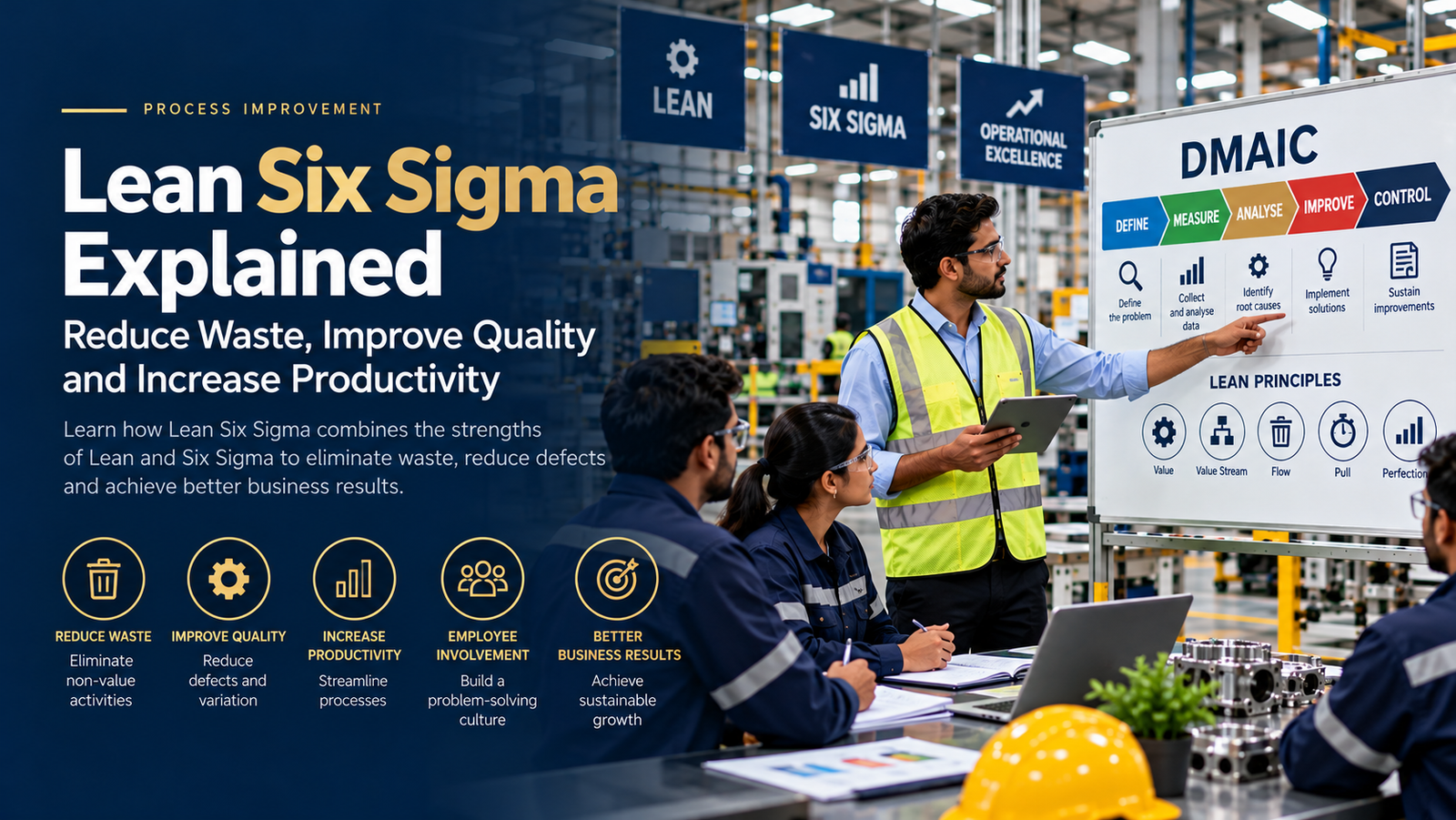
In today's competitive business environment, organisations must continuously improve quality, control costs and increase operational efficiency. Inefficient processes, unnecessary activities and recurring defects can affect profitability and customer satisfaction.
Lean Six Sigma is a structured process improvement approach that combines two powerful methodologies: Lean and Six Sigma. Together, they help organisations reduce waste, control process variation, improve quality and deliver greater value to customers.
Although Lean Six Sigma is widely used in manufacturing, it can also be applied in healthcare, logistics, financial services, information technology and administrative operations.
1. What Is Lean Six Sigma?
Lean Six Sigma combines the principles of Lean management with the analytical techniques of Six Sigma to improve business processes.
Lean seeks to remove activities that do not create value for the customer. Six Sigma uses data and statistical methods to understand process performance, identify root causes and reduce variation.
By combining these approaches, organisations can improve both process efficiency and consistency.
2. Lean vs. Six Sigma: Understanding the Difference
| Aspect | Lean | Six Sigma |
|---|---|---|
| Main Focus | Reduce waste and improve flow. | Reduce variation and defects. |
| Primary Goal | Improve efficiency and customer value. | Improve consistency and process capability. |
| Typical Tools | 5S, Value Stream Mapping, Kanban. | Control Charts, Capability Analysis, Hypothesis Testing. |
| Common Results | Reduced delays and unnecessary activities. | Lower defect rates and more stable processes. |
3. Five Core Principles of Lean
Lean is commonly explained through five fundamental principles that help organisations improve the delivery of customer value.
Identify Value
Understand what customers need and which activities contribute to meeting those needs.
Map the Process
Identify the steps involved in delivering a product or service and locate waste.
Create Flow
Reduce interruptions, bottlenecks and delays between process activities.
Establish Pull
Align production or service delivery with actual customer demand.
Pursue Improvement
Continuously improve processes to reduce waste and deliver better value.
4. The Eight Wastes of Lean Manufacturing
Lean helps organisations identify activities that consume resources without adding value. Eight common categories of waste are often remembered using the acronym DOWNTIME.
| Waste | Meaning | Example |
|---|---|---|
| Defects | Errors requiring correction or replacement. | Rejected manufactured parts. |
| Overproduction | Producing more or earlier than required. | Excess finished goods. |
| Waiting | Idle time between activities. | Operators waiting for materials. |
| Non-Utilised Talent | Not making effective use of employee skills. | Ignoring improvement suggestions. |
| Transportation | Unnecessary movement of materials. | Repeated movement between distant storage areas. |
| Inventory | Excess materials or unfinished products. | Unnecessary work-in-progress stock. |
| Motion | Unnecessary movement by people. | Searching for misplaced tools. |
| Extra Processing | Performing work beyond customer requirements. | Duplicate inspections without a clear need. |
5. The DMAIC Methodology Explained
DMAIC is one of the most widely used structured problem-solving approaches in Six Sigma. It stands for Define, Measure, Analyse, Improve and Control.
-
Define
Identify the business problem, customer requirements, project objectives and expected improvement outcomes. -
Measure
Collect reliable data about current process performance and establish a baseline for comparison. -
Analyse
Investigate the data to identify the underlying causes of defects, delays or process variation. -
Improve
Develop, test and implement solutions that address verified root causes. -
Control
Monitor the improved process, update procedures and establish controls to sustain the results.
6. Important Lean Six Sigma Tools
5S
Improves workplace organisation, cleanliness and standardisation.
Fishbone Diagram
Organises potential causes of a problem for systematic investigation.
5 Whys
Uses repeated questioning to explore underlying causes.
Value Stream Mapping
Visualises process steps, information flow and opportunities to reduce waste.
Pareto Analysis
Helps prioritise the most significant problems or sources of defects.
Control Charts
Monitor process behaviour and help detect unusual variation over time.
7. Benefits of Lean Six Sigma
Lean Six Sigma can help organisations improve operational performance through a structured and measurable approach.
- Reduced operational waste: Eliminate unnecessary activities, delays and material losses.
- Improved product quality: Identify and reduce causes of defects.
- Higher productivity: Improve workflows and resource utilisation.
- Better customer satisfaction: Deliver more consistent products and services.
- Reduced costs: Minimise rework, scrap and avoidable process expenses.
- Improved decision-making: Use reliable data to evaluate problems and solutions.
- Employee involvement: Encourage cross-functional teamwork and structured problem solving.
8. Practical Lean Six Sigma Examples
Example 1: Reducing Manufacturing Defects
A manufacturing company experiences recurring product defects. The improvement team collects inspection data, identifies major defect categories and investigates root causes. After implementing suitable controls, the team monitors the defect rate to evaluate whether the changes are effective.
Example 2: Reducing Production Waiting Time
A production line frequently stops because materials arrive late. The team maps the material flow, identifies delays and introduces a more effective replenishment process.
Example 3: Improving Customer Complaint Resolution
A service organisation receives complaints about slow response times. The team measures response delays, investigates bottlenecks and simplifies the complaint-handling workflow.
Example 4: Improving Warehouse Operations
A warehouse spends excessive time locating frequently used items. Employees reorganise storage locations, introduce clear labels and monitor order-picking time after the changes.
9. How to Implement Lean Six Sigma
-
Identify Business Objectives
Define improvement priorities linked to quality, cost, delivery or customer needs. -
Obtain Leadership Support
Ensure management provides resources, direction and support for improvement projects. -
Select Suitable Projects
Choose measurable problems with clear business relevance. -
Train Employees
Build understanding of Lean principles, Six Sigma methods and relevant tools. -
Apply DMAIC
Use the structured improvement cycle to investigate and solve process problems. -
Measure Results
Compare performance before and after implementation using suitable indicators. -
Standardise Improvements
Update work instructions, training and process controls. -
Monitor and Sustain
Review performance regularly and identify further improvement opportunities.
10. Lean Six Sigma Belt Levels
Many Lean Six Sigma training programmes use belt levels to describe different levels of knowledge and project responsibility. Exact curricula and requirements vary between training providers.
| Belt Level | Typical Role |
|---|---|
| White Belt | Basic awareness of improvement concepts. |
| Yellow Belt | Supports improvement projects and data collection. |
| Green Belt | Leads smaller projects or supports complex initiatives. |
| Black Belt | Leads complex improvement projects and coaches teams. |
| Master Black Belt | Provides advanced technical guidance and programme leadership. |
11. Lean Six Sigma and ISO Management Systems
Lean Six Sigma can support organisations implementing management systems such as ISO 9001, ISO 14001, ISO 45001 and IATF 16949.
- ISO 9001: Supports process improvement, performance evaluation and corrective action.
- ISO 14001: Can help reduce material waste and improve resource efficiency.
- ISO 45001: Structured problem solving can support improvements to workplace safety processes.
- IATF 16949: Supports defect reduction, process stability and continual improvement.
Lean Six Sigma is not a substitute for the requirements of any ISO management system standard.
12. Frequently Asked Questions
Q1. What is Lean Six Sigma in simple words?
Lean Six Sigma is a method for improving business processes by reducing waste, defects and unnecessary variation.
Q2. What does DMAIC stand for?
DMAIC stands for Define, Measure, Analyse, Improve and Control.
Q3. Is Lean Six Sigma only for manufacturing?
No. It can also be used in healthcare, banking, logistics, IT, administration and other service industries.
Q4. What is the difference between Lean and Six Sigma?
Lean primarily focuses on waste reduction and process flow. Six Sigma focuses on reducing variation and defects using data.
Q5. Is Lean Six Sigma an ISO certification?
No. Lean Six Sigma is an improvement methodology. Training providers may offer belt certifications, but these are not equivalent to ISO management system certification.
Q6. Can small businesses use Lean Six Sigma?
Yes. Small businesses can apply suitable tools to improve workflows, reduce errors and solve recurring operational problems.
Q7. How long does a Lean Six Sigma project take?
Project duration depends on its scope, complexity, data availability and resources. Smaller improvements may take weeks, while complex projects may require months.
Improve Quality and Operational Performance
Reduce process waste, strengthen quality management and develop a culture of measurable improvement with professional guidance from Vedanta Management Advisory Group.
Talk to Our ExpertsDisclaimer: This article provides general educational information. Improvement methods should be selected and implemented according to the organisation's processes, risks and business objectives.